
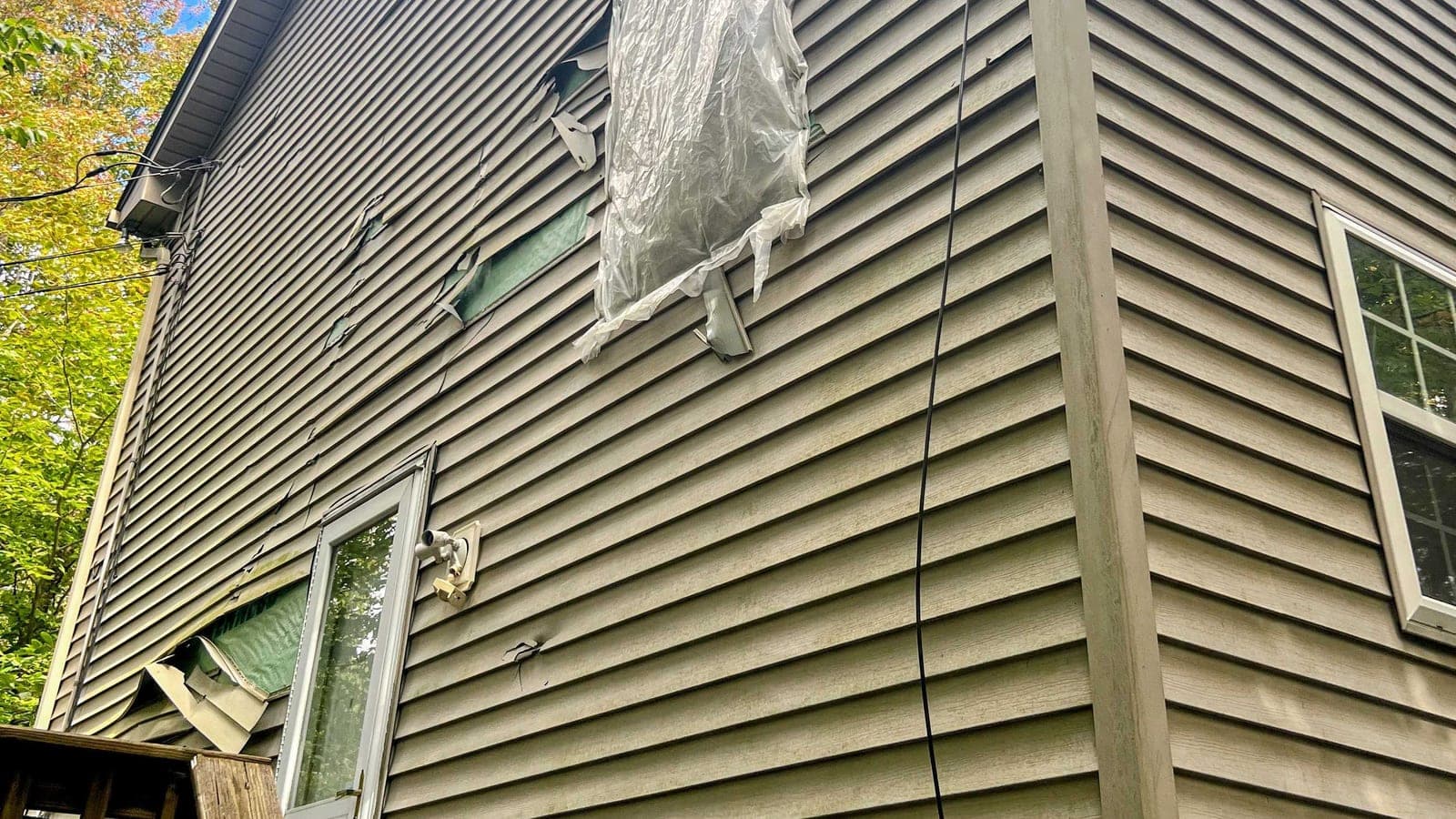
Selling a Fire- or Water-Damaged House in Pennsylvania
By Alex Buys HomesPublished 11 min read
A fire, a burst pipe or a flooded basement can turn a home into a project overnight. Suddenly you’re dealing with an insurance adjuster, contractor estimates and a mortgage that’s still due, and you may be wondering whether rebuilding is even worth it.
You have three realistic paths: repair and stay, repair and sell, or sell the house as-is. This guide covers the first steps after the damage, how insurance claims and Pennsylvania’s disclosure rules work, and how to compare repairing with selling. It reflects the rules as of September 2026.
Key takeaways
- You can sell a damaged house as-is, but in most sales Pennsylvania’s Real Estate Seller Disclosure Law still requires you to disclose known material defects in writing before the buyer signs.
- Call your insurer right away, photograph the damage before cleanup, and make only the repairs needed to prevent more damage until the insurer approves permanent work.
- Pennsylvania insurers must acknowledge a claim within 10 working days and finish investigating within 30 days, or explain the delay in writing.
- Allentown, Bethlehem, Easton and Reading have fire insurance escrow ordinances on file with the state, so part of a large fire payout can be held until the building is repaired, removed or secured.
- The EPA advises drying water-damaged areas within 24 to 48 hours to prevent mold.
Can you sell a fire- or water-damaged house in Pennsylvania?
Quick answer
Yes. You can sell a fire- or water-damaged house in Pennsylvania as-is or after repairs. In most sales, the Real Estate Seller Disclosure Law requires you to disclose the material defects you know about on a written statement before the buyer signs. Your insurance claim, your mortgage lender and local code rules affect the timing.
What should you do first after a fire or water damage?
Quick answer
Make sure the house is safe, then call your insurance company as soon as possible. Photograph the damage before you clean up, make only the temporary repairs needed to stop further damage, keep every receipt, and dry out wet areas within 24 to 48 hours to prevent mold.
- Wait for the all-clear. After a fire, the U.S. Fire Administration says not to go back inside until the fire department says it’s safe, and not to turn utilities back on yourself if firefighters shut them off.
- Call your insurer and your mortgage company. The Pennsylvania Insurance Department says to contact your insurance company as soon as possible. The Fire Administration also recommends reporting a fire to your mortgage company.
- Document before you clean. Take photos and video of every room, damaged belongings and the outside of the house before anything is thrown out or repaired.
- Prevent more damage. Board up openings, cover a damaged roof and shut off a leaking water line. The Insurance Department’s advice is to make the repairs needed to prevent further damage but hold off on permanent repairs until your insurer approves them.
- Dry it out fast. The EPA’s rule of thumb is to get wet materials and belongings dry within 24 to 48 hours; in most cases, that keeps mold from taking hold.
- Keep every receipt. Hotel stays, supplies and emergency repairs may be reimbursable, depending on your policy.
- Secure a vacant house. If you can’t stay there, the Fire Administration suggests telling the local police department the house will be empty.
How do insurance claims work for fire and water damage in Pennsylvania?
Quick answer
You report the loss, the insurer investigates, and you submit a proof of loss. Pennsylvania regulations require insurers to acknowledge a claim within 10 working days and finish investigating within 30 days or explain the delay in writing. Within 15 working days after a properly completed proof of loss, the insurer must accept or deny the claim or tell you in writing why it needs more time.
| Claim step | What Pennsylvania requires | Rule |
|---|---|---|
| Insurer acknowledges your claim | Within 10 working days of notice, unless it pays within that time | 31 Pa. Code § 146.5 |
| Investigation | Within 30 days, or a written explanation at 30 days and every 45 days after that | 31 Pa. Code § 146.6 |
| Decision after proof of loss | Accept or deny within 15 working days, or explain in writing why more time is needed; a denial must be in writing and cite any policy provision it relies on | 31 Pa. Code § 146.7 |
A few parts of the process surprise many owners:
- Your lender is usually on the check. The Consumer Financial Protection Bureau explains that the insurer’s check generally names both you and your mortgage servicer. The servicer then pays the money out in stages: some before work starts, the last of it after the repairs pass inspection. Your mortgage payments are still due meanwhile.
- Flood is a separate policy. Standard homeowners and renters policies don’t cover flood damage, according to the Pennsylvania Insurance Department; flood coverage is sold separately, including through FEMA’s National Flood Insurance Program. For other water damage, such as a burst pipe, ask your insurer what your policy covers and whether it covers mold.
- Living expenses. If a covered loss makes the house unlivable, the loss-of-use part of a homeowners policy can pay extra living costs during repairs. The Insurance Department says that coverage is typically 20 percent of the dwelling limit.
- Public adjusters. A public adjuster handles the claim for a fee, usually a percentage of the claim. They must be licensed by the Insurance Department, you don’t have to hire one, and state law gives you three calendar days after signing to cancel the contract.
- If you disagree. You can appeal to your insurer’s claim manager and file a complaint with the Insurance Department online or at 1-877-881-6388.
One tax note: a personal casualty loss is generally deductible only if it’s caused by a federally declared disaster or, for losses in 2026 and later, a state-declared disaster. Ask a tax professional how that applies to you.
What is Pennsylvania’s fire insurance escrow?
In municipalities that adopt it, a state law changes how large fire claims are paid. Before paying a fire claim over $7,500, the insurer needs a certificate from the municipal treasurer listing any delinquent taxes and charges, and it pays those out of the claim. When the agreed loss is 60 percent or more of the limits on all fire policies covering the building, the insurer sends the municipality $2,000 for every $15,000 of the claim to hold in escrow, or less if you’ve submitted a signed contractor’s estimate for a smaller amount.
The municipality returns the escrow once the building has been repaired, removed or secured and it has the proof it needs. If the municipality had to pay to repair, remove or secure the building itself, those costs come out first and any balance goes back to you. The Department of Community and Economic Development’s registry lists escrow ordinances for Allentown, Bethlehem, Easton and Reading. If you plan to sell before repairs are finished, ask your insurer and the city how the escrow will be released.
Do you have to disclose fire or water damage when you sell a house in Pennsylvania?
Quick answer
Usually, yes. Pennsylvania’s Real Estate Seller Disclosure Law requires sellers of homes with one to four units to disclose known material defects on a property disclosure statement before the agreement of sale is signed. Selling as-is doesn’t remove that duty. A few transfers are exempt, including sales by an estate’s executor and property the buyer will demolish.
Here’s what the law says, in plain terms:
- What counts. The law defines a material defect as a problem that would significantly hurt the property’s value or that poses an unreasonable risk to people on the property. A part that is simply old or near the end of its useful life isn’t a material defect by itself (68 Pa.C.S. § 7102).
- What the form asks. The State Real Estate Commission’s form, which sets the minimum a disclosure statement must cover, asks about past or present water leakage, water or dampness in the basement, roof leaks and repairs, structural problems, flooding or drainage problems, and uncorrected violations of building or fire codes. It ends with a catch-all for any other material defect you know about.
- Damage during the sale. If a fire or leak happens after you give the buyer your disclosure but before settlement, you must tell the buyer the information is no longer accurate (§ 7307).
- No duty to investigate, no hiding. You don’t have to hire inspectors to complete the form, but you can’t make statements you know, or have reason to know, are false or misleading, and you can’t leave out a known material defect (§ 7308).
- The cost of getting it wrong. A seller who willfully or negligently violates the law is liable for the buyer’s actual damages, and a buyer has two years after settlement to sue (§ 7311).
- Exemptions. The disclosure rules don’t apply to transfers by a fiduciary, such as an executor, guardian or trustee, administering an estate or trust (§ 7302), foreclosure and other court-ordered sales, transfers to a spouse or direct relatives, or sales of property the buyer will convert to a nonresidential use or demolish (§ 7103). Other laws against fraud and misrepresentation still apply (§ 7313).
Disclosure protects you, too. A buyer generally has no claim under this law for a defect you disclosed before the agreement was signed (§ 7314). For most homes built before 1978, federal rules also require you to disclose known lead-based paint and lead hazards, give the buyer the EPA’s lead pamphlet, and offer a 10-day window to test, which the buyer can waive.
Do you have to disclose mold when selling a house in Pennsylvania?
The state form doesn’t ask about mold by name, but it asks about past or present water leakage and dampness, and it requires you to list any other material defect you know about. Mold growth that comes from water damage can fall into either category, so the safer course is to disclose what you know and what was done about it.
For cleanup, the EPA says a homeowner can usually handle a moldy area smaller than about 10 square feet. For bigger areas it points to its remediation guidance, and it recommends a professional when the water was sewage or otherwise contaminated. Keep records of any cleanup so you can answer buyers’ questions.
Do you need permits to repair fire or water damage?
It depends on the work and your municipality. Pennsylvania’s Uniform Construction Code says ordinary repairs don’t need a permit, but cutting away a load-bearing wall, removing structural beams, changing a required exit, or adding or moving wiring, piping or mechanical systems doesn’t count as ordinary repair. Call your local code office before work starts.
According to the Department of Labor & Industry, more than 90% of Pennsylvania municipalities enforce the construction code locally, with their own staff or a hired third-party agency, so rules and inspection schedules vary. Permits and inspections take time, which adds holding costs if you plan to repair and then sell.
Should you repair the house or sell it as-is?
Quick answer
Repair first when insurance will cover most of the work, you have the time and cash to manage contractors, and the finished house would sell for clearly more than the repairs cost. Sell as-is when repairs would outrun the payout, the house is unlivable, or you need to move on quickly. Run the numbers both ways first.
A simple worksheet keeps the comparison honest. Use real contractor quotes and your actual insurance figures, not guesses:
| Step | Repair, then sell | Sell as-is |
|---|---|---|
| 1. Start with | What the repaired house should sell for (its after-repair value) | The as-is offer or as-is list price |
| 2. Subtract repairs | Repair costs your insurance won’t pay | None |
| 3. Subtract holding costs | Mortgage, taxes, insurance and utilities for the months of permits, work and marketing | Usually fewer months |
| 4. Subtract selling costs | Agent commission, your share of transfer tax and other closing costs | Whatever the buyer’s terms leave to you |
| 5. Compare | Your net after repairs | Your net from the as-is sale |
Cash buyers run the same math from the other side. Our formula is published on the how it works page: the after-repair value minus renovation costs, holding and selling costs, and our minimum profit. That’s why an as-is cash offer on a badly damaged house will be well below what the repaired house could bring. What you get in exchange is speed, certainty and no rebuild to manage. Our guide on how we calculate your cash offer shows the math, and you can request a no-obligation offer to compare with your repair numbers.
When is listing the better choice? If the damage is limited, insurance covers the repairs and you can live elsewhere while the work is done, repairing and then listing with an agent will often put more money in your pocket. Our comparison of a cash buyer vs. listing with an agent covers the trade-offs.
Weighing an as-is sale?
We buy houses as-is, in any condition, with no commissions or fees. Tell us about the property and we typically make a no-obligation cash offer within 24 hours. You choose the closing date.
We buy houses across the Lehigh Valley and beyond, including Allentown, Bethlehem, Easton and Reading. If the damaged house is a rental, read our guide to selling a house with tenants in Pennsylvania. If you’re handling it for an estate, see selling an inherited house in Pennsylvania.
Please note
This guide is general information as of September 2026, not legal, insurance or tax advice. Your policy, your sale contract and local ordinances all affect your rights. Talk with a Pennsylvania real estate attorney about disclosure, and with your insurer or a licensed public adjuster about your claim, before you act.
Sources
Official sources, checked September 29, 2026:
- Real Estate Seller Disclosure Law, 68 Pa.C.S. Chapter 73 (Pennsylvania General Assembly)
- Definitions and exclusions, 68 Pa.C.S. Chapter 71 (§§ 7102, 7103) (Pennsylvania General Assembly)
- Seller’s property disclosure statement, 49 Pa. Code § 35.335a
- Acknowledging claims, 31 Pa. Code § 146.5
- Standards for prompt investigation of claims, 31 Pa. Code § 146.6
- Standards for prompt, fair and equitable settlements, 31 Pa. Code § 146.7
- Pennsylvania Insurance Department: Natural disaster insurance guide
- Pennsylvania Insurance Department: Homeowners insurance guide (PDF)
- Pennsylvania Insurance Department: Public adjusters
- Public Adjuster Licensing Law, 1983 Act 72 (Pennsylvania General Assembly)
- Pennsylvania Insurance Department: Complaints, questions and help
- Pennsylvania Insurance Department: Flood insurance
- FEMA: Flood insurance
- CFPB: How do home insurance companies pay out claims?
- U.S. Fire Administration: Helping residents after a home fire
- U.S. Fire Administration: “After the Fire” brochure (PDF)
- DCED: Fire insurance escrow
- DCED: Fire escrow registry by county
- Insurance Company Law of 1921, section 508 (40 P.S. § 638) (Pennsylvania General Assembly)
- EPA: A brief guide to mold, moisture and your home
- EPA: Mold cleanup in your home
- Uniform Construction Code permit requirements, 34 Pa. Code § 403.62
- Department of Labor & Industry: Uniform Construction Code
- EPA: Real estate disclosures about potential lead hazards
- IRS: Topic 515, casualty, disaster and theft losses
- IRS: Casualty loss deduction expanded and made permanent

About Alex Buys Homes
Alex Buys Homes LLC is a cash home buying company with an office at 450 Union Blvd., 4th Floor, Allentown, PA 18109. We buy houses as-is, in any condition, across Allentown, the Lehigh Valley and the other Pennsylvania communities listed on our locations page. You pay no commissions or fees, we typically make a cash offer within 24 hours, and you choose the closing date.
Questions? Call 610-890-8220 or email [email protected].
Articles on this blog are general information, not legal, tax or financial advice.